 Kerala Backwaters Escape
Destination
In the dry red-sandstone country of northern Karnataka, three villages within a short drive of each other hold some of the oldest surviving Hindu temples in India. Between the 6th and 8th centuries, the Chalukya kings ruled much of the Deccan from their capital at Badami, then known as Vatapi. Their builders cut temples into cliffs, experimented with free-standing stone shrines at Aihole, and finally created a royal ceremonial center at Pattadakal, where kings were crowned. Together, these sites show how Indian temple architecture took shape, and historians often call the area the cradle of temple building in South India.
For travelers, the three places make a natural group. Badami is the base, a small town wrapped around a green artificial lake and framed by two cliffs, with four cave temples carved into one of them. Aihole, about 35 km (22 miles) away, has more than a hundred temples scattered through and around the village, some still sitting between people's houses. Pattadakal, between the two, is the most refined of the three and is listed as a UNESCO World Heritage Site. You'll see northern-style curved towers and southern-style stepped towers standing side by side in the same courtyard.
The area receives a fraction of the visitors that Hampi gets, and that's part of the appeal. A Badami Aihole Pattadakal tour fits neatly between Hampi and Goa or Bijapur, and most private itineraries stop here for one or two nights. Facilities are simpler than in the big cities, but the monuments are well kept, the roads are good, and you'll often have a temple almost to yourself.
Badami Cave Temples, Agastya Lake, Bhutanatha Temples, Pattadakal Group of Monuments, Durga Temple Aihole, Banashankari Temple
October – February.
Cool mornings for climbing and walking
2 Days
1 night is possible with an early start
Kannada, some English
Guides speak English; little English in villages
The usual plan is to stay in Badami and explore in this order. Spend your first morning or late afternoon at the Badami Cave Temples and Agastya Lake, when the light is good and the steps are cooler. On the second day, drive out to Aihole first (about 1 hour), as it's the furthest point, then return via Pattadakal (about 30 minutes from Aihole) and Mahakuta on the way back to Badami. This loop is roughly 80 km (50 miles). If you only have one night, you can see the caves on arrival afternoon and do the Aihole–Pattadakal loop the next morning before leaving. A knowledgeable guide is especially useful here, because many temples are unlabeled and the differences between building styles are easy to miss without explanation.
This is rural North Karnataka, and food is hearty and spicy. The staple is jolada rotti, a thin, crisp flatbread made of sorghum, eaten with ennegai (stuffed baby eggplant curry), spiced lentils, raw onion, green chili, and powdered chutneys made from flaxseed and peanuts. A full North Karnataka meals at a local restaurant is filling and inexpensive. Try girmit, a puffed-rice snack tossed with onions and spices, and mirchi bajji (chili fritters) at tea stalls. Restaurant choice in Badami is limited, so most travelers eat at their hotel, where kitchens will make milder dishes on request.
Read More +Like what you see? Let's plan it for you.
Private car, driver and hotels arranged around your dates. Reply within 24 hours.
Badami, Aihole and Pattadakal
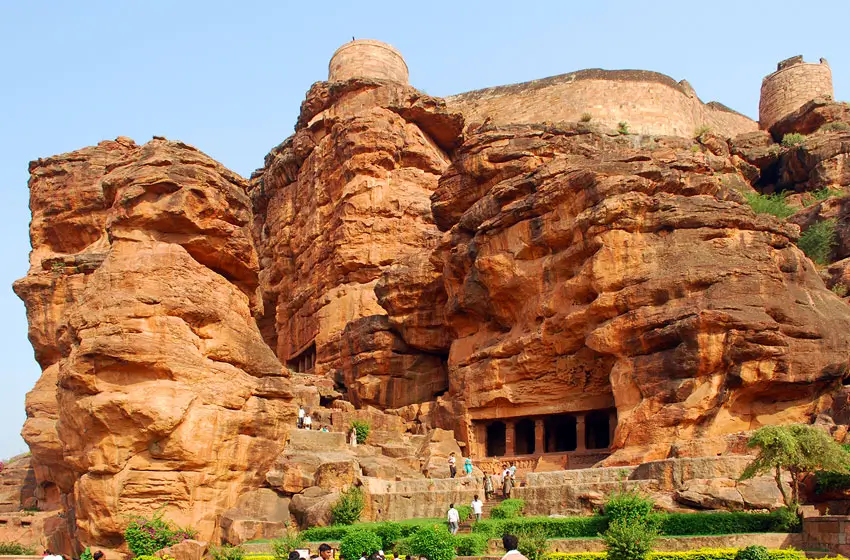
The Badami Cave Temples are the main reason to come here. Four caves were carved into the red sandstone cliff on the south side of town, connected by steep steps that climb higher with each one. Cave 1, the lowest and probably the oldest, is dedicated to Shiva and holds a celebrated carving of him dancing with 18 arms, with each arm placed in a different dance gesture. Cave 2 and Cave 3 are dedicated to Vishnu. Cave 3, completed in 578 according to an inscription, is the largest and finest, with huge panels of Vishnu as the boar Varaha, as the giant Trivikrama striding across the universe, and seated on the coiled serpent Ananta. Traces of original painting survive on its ceiling. Cave 4, at the top, is a smaller Jain cave with carvings of the Tirthankaras. From the platforms between the caves you get fine views down over Agastya Lake and the old town. Expect monkeys on the steps and keep food out of sight.
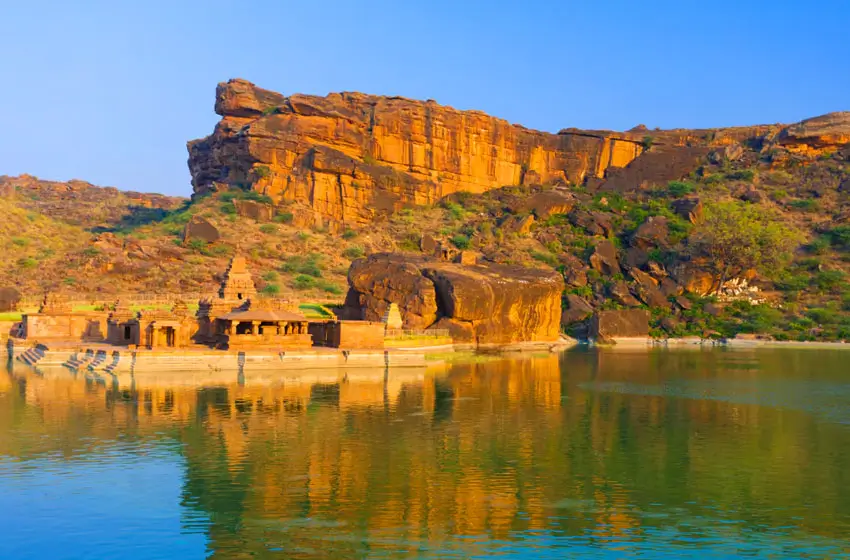
Agastya Lake sits in a natural bowl between the two cliffs and was created by the Chalukyas in the 5th century. Local women still wash clothes on its stone ghats, and old houses climb the slopes around it. On the eastern shore, the Bhutanatha group of temples stands right at the water's edge, and their reflection in the lake at sunrise or late afternoon is one of the best photographs in Karnataka. Walking around the lake and through the lanes of the old town, with its whitewashed homes and painted doorways, is one of the quiet pleasures of a stay in Badami.
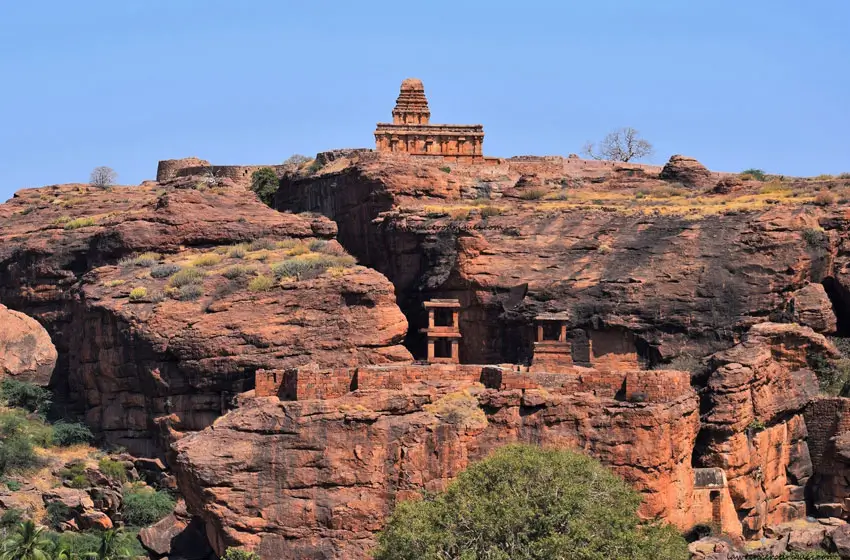
On the cliff north of the lake, a path leads through narrow sandstone gorges and old gateways to the North Fort and the Upper Shivalaya, one of the oldest structural temples in the area. The climb takes about 45 minutes and passes granaries, a watchtower, and cannon emplacements from later centuries when Tipu Sultan held the fort. The view from the top across the town, the lake, and the red cliffs is excellent, especially in the early morning. Next to the lake on this side is the Archaeological Museum, with sculptures from the region and a well-known image of the fertility goddess Lajja Gauri. ASI museums like this one are generally closed on Fridays.
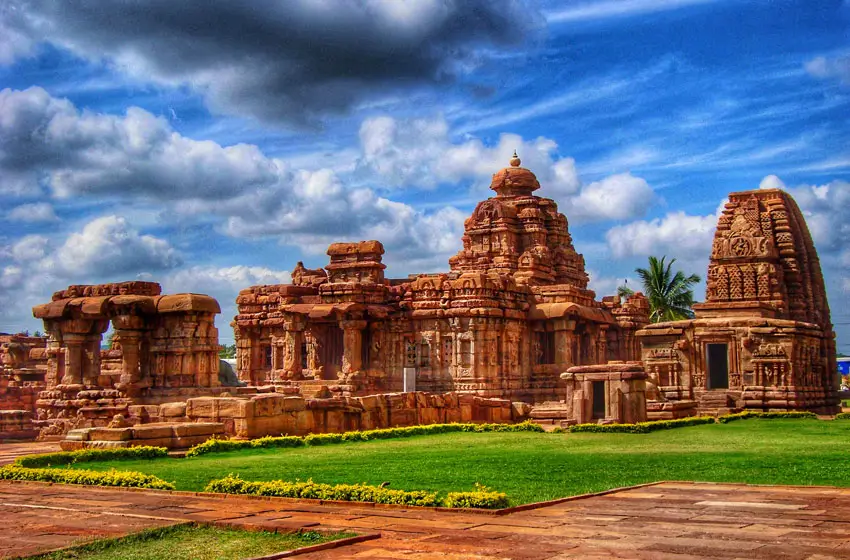
The Pattadakal temples were added to the UNESCO World Heritage list in 1987, and they stand together in a single walled lawn on the bank of the Malaprabha River. Ten major temples were built here, mostly in the 7th and 8th centuries, and this is where the Chalukya kings held their coronations. What makes Pattadakal special is that both main styles of Indian temple architecture appear side by side: the Nagara style of the north, with curved towers, and the Dravida style of the south, with stepped, pyramid-like towers. The largest and finest is the Virupaksha Temple, built by Queen Lokamahadevi around 745 to celebrate her husband's victory over the Pallavas. It's still in worship, and its walls and pillars are carved with scenes from the Ramayana, Mahabharata, and Panchatantra stories. Next to it, the Mallikarjuna Temple was built by her sister, also a queen, and is similar in plan. Plan about two hours here with a guide.
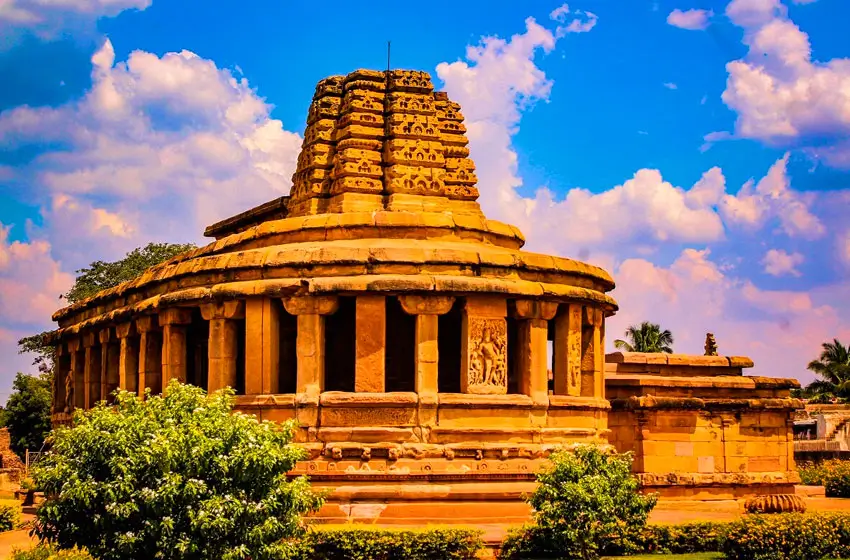
The most famous building in Aihole is the Durga Temple, which has an unusual rounded back end like a Buddhist chaitya hall and a covered gallery running around the whole sanctuary. Its name comes from "durg" (fort) as it stood near the old defensive walls, rather than from the goddess Durga. The pillars of its porch are carved with loving couples and guardian figures, and inside the gallery are fine panels of Vishnu, Shiva, and Durga killing the buffalo demon. The Durga Temple sits in a fenced complex with several other early shrines and a small museum of sculptures.
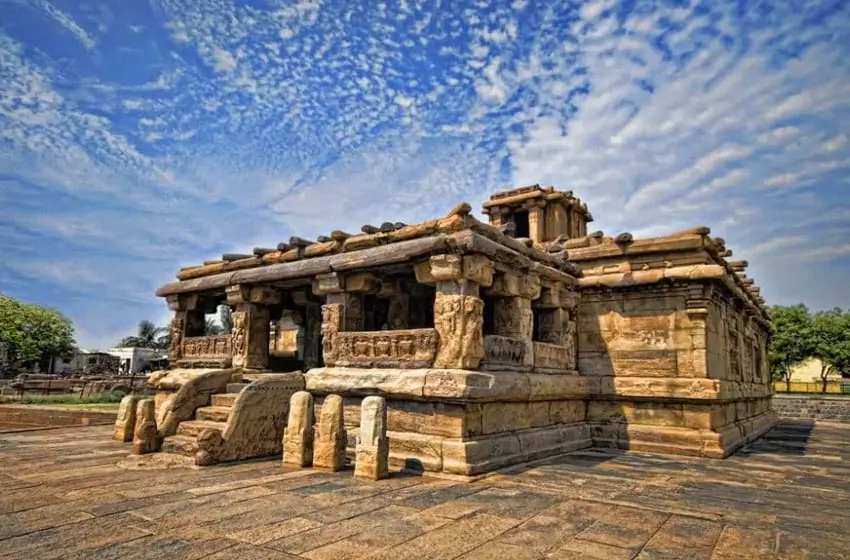
Next to the Durga Temple is the Lad Khan Temple, one of the oldest in Aihole, a flat-roofed square hall that looks more like a village meeting hall than a temple. It was named after a man who lived in it in the 19th century. Around the village you'll find dozens more: the Ravanaphadi cave temple with tall carvings of Shiva and dancing figures, the Hucchimalli Temple, the Gaudargudi, and on the hill above the village, the Meguti Jain Temple. The Meguti carries the Aihole inscription of 634 by the poet Ravikirti, which records the victories of King Pulakeshin II and is one of the most important historical inscriptions in South India. The climb up is short, and the view of the temple-dotted village below is worth it.
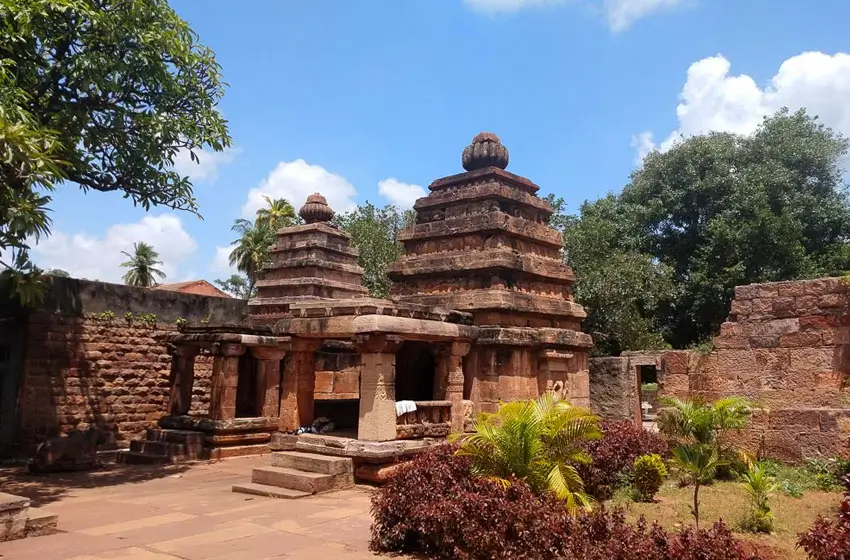
Off the road between Badami and Pattadakal, the Mahakuta temple complex is a group of Chalukya shrines set around a natural spring-fed tank. Unlike most of the area's monuments, these temples are still in active use, and pilgrims bathe in the green water of the pool. It's a pleasant and authentic stop, especially in the morning when local families come to worship.
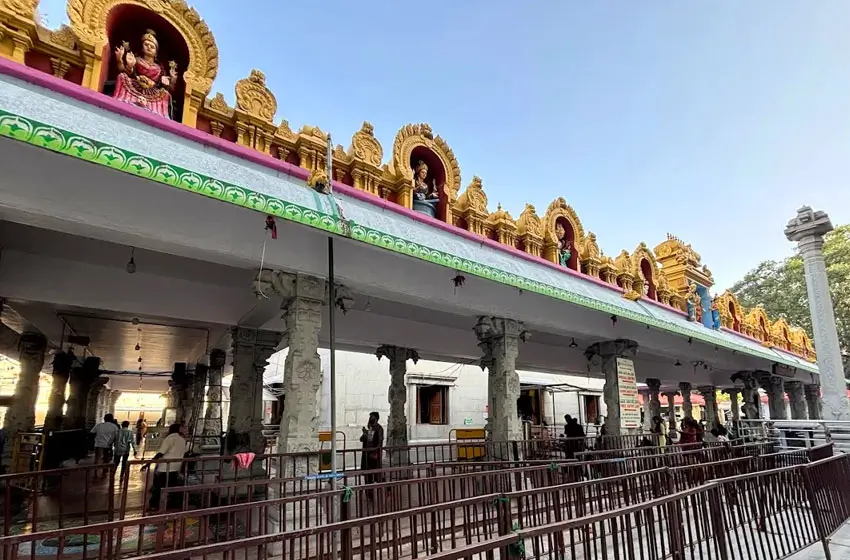
About 5 km from Badami, the Banashankari Temple is dedicated to the goddess Banashankari, a form of Parvati, and is a major pilgrimage site in the region. The present temple dates from the 17th century and stands next to a large tank surrounded by pillared corridors. In January or February, the Banashankari Jatra brings a large fair with bullock carts, food stalls, and religious processions, an interesting time to visit if you don't mind crowds.
Like what you see? Let's plan it for you.
Private car, driver and hotels arranged around your dates. Reply within 24 hours.
Getting there
Badami is the gateway to all three sites and is easiest to reach by road from Hampi or Hubli.
Hubli Airport (about 2.5–3 hours) and Belagavi Airport (about 3 hours), both with domestic flights; the nearest international airports are Goa and Bengaluru
Badami railway station (about 5 km from town), on the Hubli–Solapur line, with limited trains; Hubli Junction has more connections
Good highways to Hampi (about 3 to 3.5 hours), Bijapur (about 2.5 hours), and Hubli (about 2.5 to 3 hours)
Tours that include Badami, Aihole and Pattadakal
Explore more
Kerala Backwaters Escape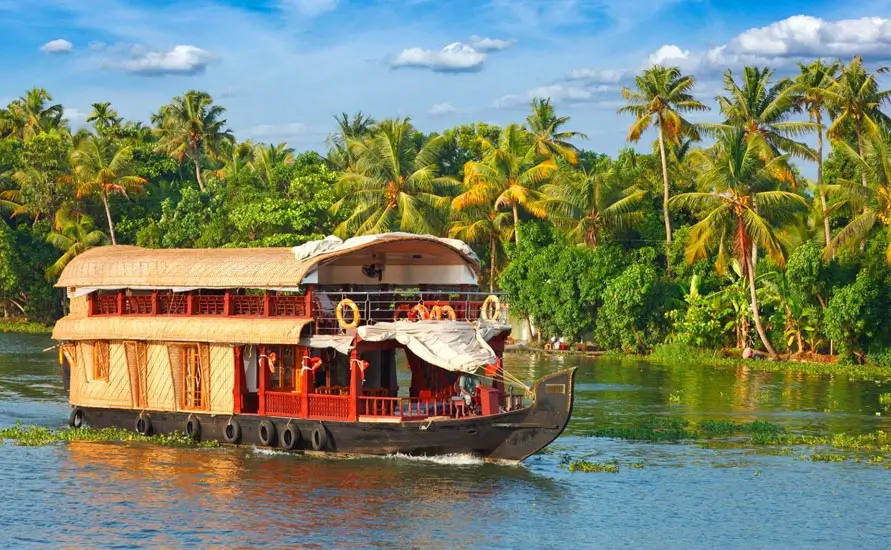 Kerala Backwaters Escape
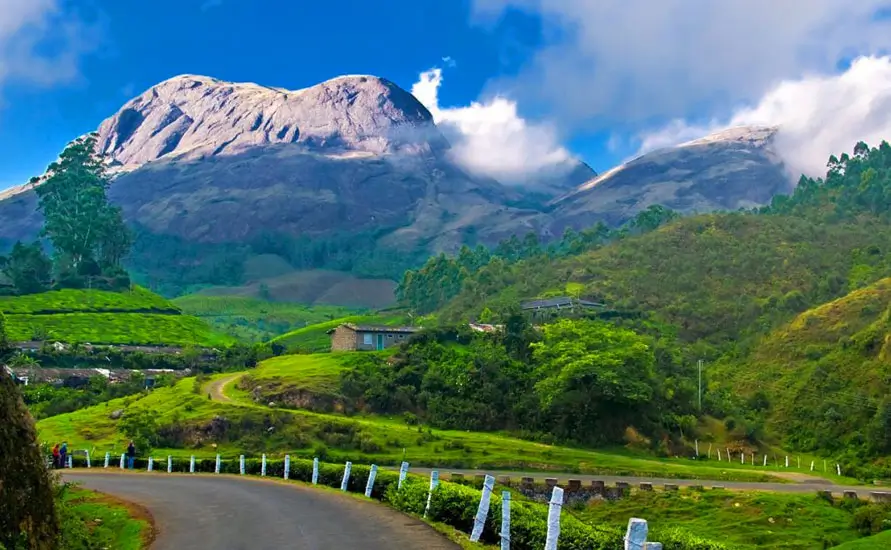 Kerala Backwaters Escape
N.S. Rathore & Mrs. Omlata Rathore · Managing Director
We still read every enquiry ourselves. Tell us the places you liked and our planners will send a day-by-day route with drive times and a clear price.
No ready-made packages and no pressure to book. A planner from our Kochi office replies within 24 hours with a route written for your group.
Fill this in and your planner will send a first draft itinerary.