 Kerala Backwaters Escape
Destination
Rameswaram is a small island town at the southeastern tip of India, separated from the mainland by the Pamban Channel and lying closer to Sri Lanka than to most of Tamil Nadu. For Hindus it is one of the holiest places in the country. It is one of the four Char Dham pilgrimage sites, and its great Shiva temple holds one of the twelve Jyotirlingas. Pilgrims arrive here from every corner of India, often at the end of a lifetime of saving for the trip.
According to the Ramayana, this is where Lord Rama worshipped Shiva after returning from Lanka, and where his army of monkeys built a bridge of stones across the sea. That story is present everywhere you go: in the temple, in the shallow sandbanks of Adam's Bridge (Ram Setu) stretching toward Sri Lanka, and in small shrines that display "floating stones." Even if you don't follow the mythology, the island has a strong and unusual character, with windswept beaches, fishing villages, and wide views of two different seas.
For foreign travelers, a visit to Rameswaram usually means three highlights. The first is the vast Ramanathaswamy Temple with its famous corridors. The second is the ghost town of Dhanushkodi, wrecked by a cyclone in 1964, and the road to Land's End beyond it. The third is the crossing of the Pamban Bridge, by road or rail, over turquoise water. Rameswaram fits naturally into a southern Tamil Nadu tour from Madurai, either as a long day trip or, much better, as an overnight stay.
Ramanathaswamy Temple, Dhanushkodi, Arichal Munai, Pamban Bridge, APJ Abdul Kalam Memorial
October – March.
Milder heat and calmer sea breezes
1–2 Days
One night lets you see the temple at dawn and Dhanushkodi without rushing
Tamil, Hindi, English.
English is limited outside hotels, so a guide helps
Dhanushkodi is the highlight for many foreign travelers, so a little planning helps:
Food in Rameswaram is simple and mostly vegetarian near the temple, since the town serves pilgrims from all over India. You'll find South Indian meals on a banana leaf, idli, dosa, and pongal, and also North Indian thalis, chapati, and dal for visitors from the north. Away from the temple streets, small restaurants serve fresh seafood: fried fish, prawn curry, crab masala, and squid, often caught that morning. At Dhanushkodi, stalls fry fish to order on the beach. Try fresh tender coconut water to beat the heat, and palm sugar sweets and palm fruit (nungu) in season. Restaurant standards are basic, so many visitors prefer to eat at their hotel.
Read More +Like what you see? Let's plan it for you.
Private car, driver and hotels arranged around your dates. Reply within 24 hours.
Rameswaram
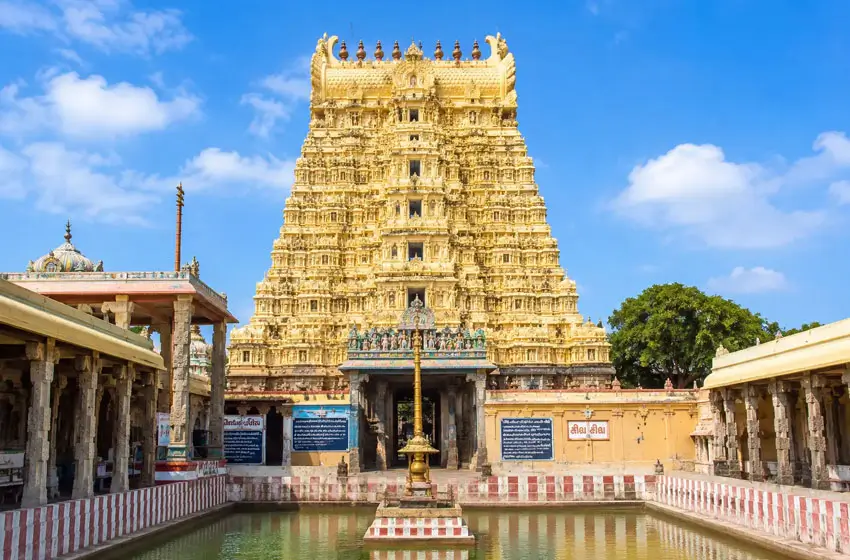
The Ramanathaswamy Temple dominates the town and is the main reason pilgrims come here. Its present form dates mostly from the 12th to 17th centuries, built and expanded under the Pandyas and later the Sethupathi rulers of Ramanathapuram. The temple is best known for its corridors, often called the longest temple corridors in India. Thousands of carved granite pillars line passages that run for hundreds of yards, with painted ceilings fading into the distance. The view down the third corridor is one of the great sights of South Indian architecture. The temple also contains 22 sacred wells (theerthams), and pilgrims move from one to the next while attendants pour a bucket of water from each over their heads. Many visitors walk around soaking wet. Non-Hindus can usually see the corridors and much of the complex, but the inner sanctums are reserved for Hindu worshippers. Mobile phones and cameras are generally not allowed inside, so leave them in the car or at the deposit counter.
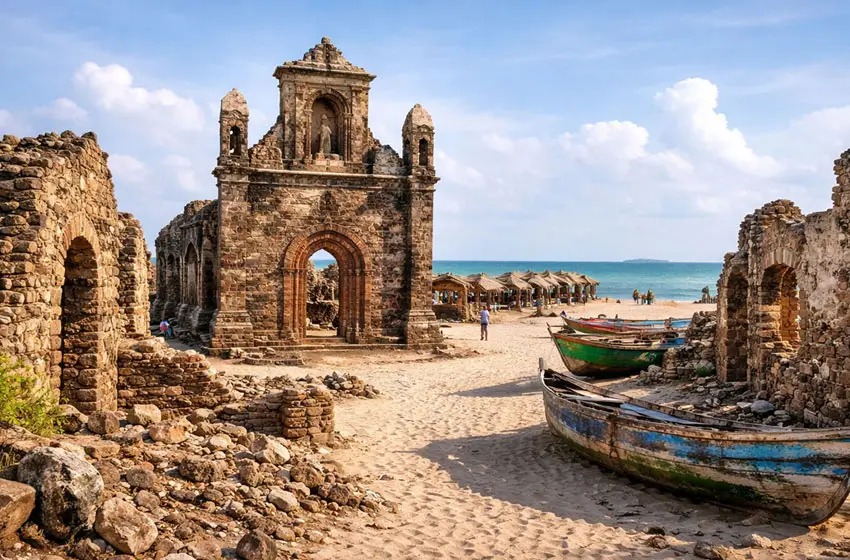
About 12 miles (20 km) southeast of Rameswaram, Dhanushkodi was once a busy port town with a railway station, a church, a post office, and a ferry service to Sri Lanka. On the night of December 22, 1964, a powerful cyclone and storm surge destroyed the town and a passenger train that was approaching it, killing hundreds of people. The town was never rebuilt. Today you can walk among the roofless shell of the church, the broken railway station, and coral-stone walls standing in the sand, while a few fishing families still live in simple huts nearby. It's a haunting place, made stranger by the beauty around it, with the calmer Palk Bay on one side and the rougher Gulf of Mannar on the other.
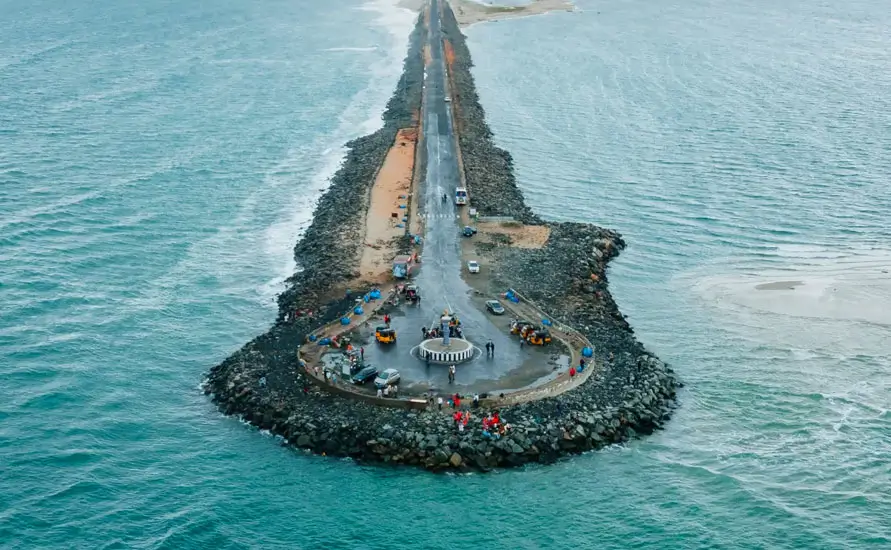
The road beyond Dhanushkodi ends at Arichal Munai, a narrow tip of sand where the two seas meet. A national emblem pillar marks the spot, and from here Sri Lanka is only about 18 miles (29 km) away across shallow water, though you can't see it from the shore. Until the new road opened in 2017, getting here meant hiring a jeep and crossing the sand. Now it's a smooth drive with sea on both sides, one of the most memorable short roads in India. Access is controlled by the police and the area closes to visitors before dark, and it can be shut completely during rough weather or high-swell warnings, so plan to go in the morning or early afternoon.
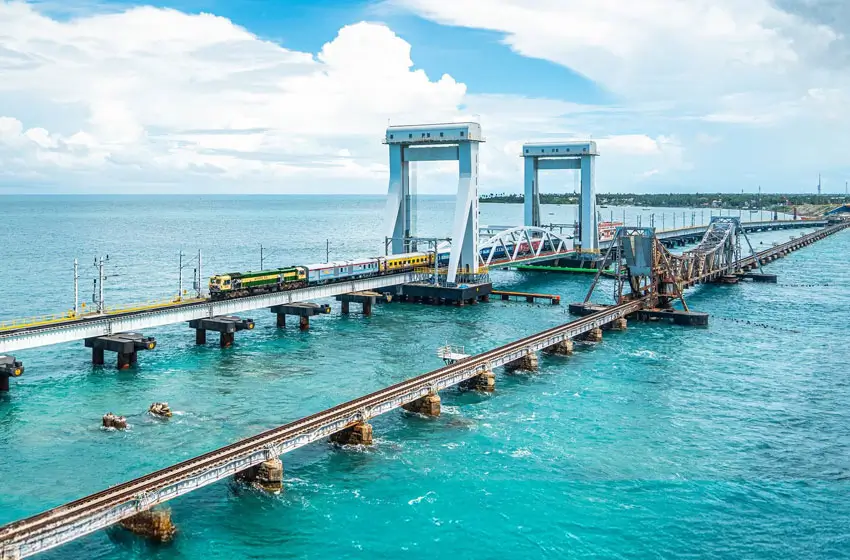
The Pamban Bridge links Rameswaram island to the mainland across the Pamban Channel. The original railway bridge, opened in 1914, was India's first sea bridge and had a famous lift span that opened for passing boats. It was retired after more than a century of service, and a new railway bridge with a vertical-lift span was inaugurated in April 2025, bringing trains back to the island. Running alongside is the Annai Indira Gandhi Road Bridge, opened in 1988. Most visitors stop at the viewpoints along the road bridge to photograph the rail bridges, the fishing boats, and the clear blue-green water below. Stopping on the bridge itself is regulated, so let your driver choose a safe spot.
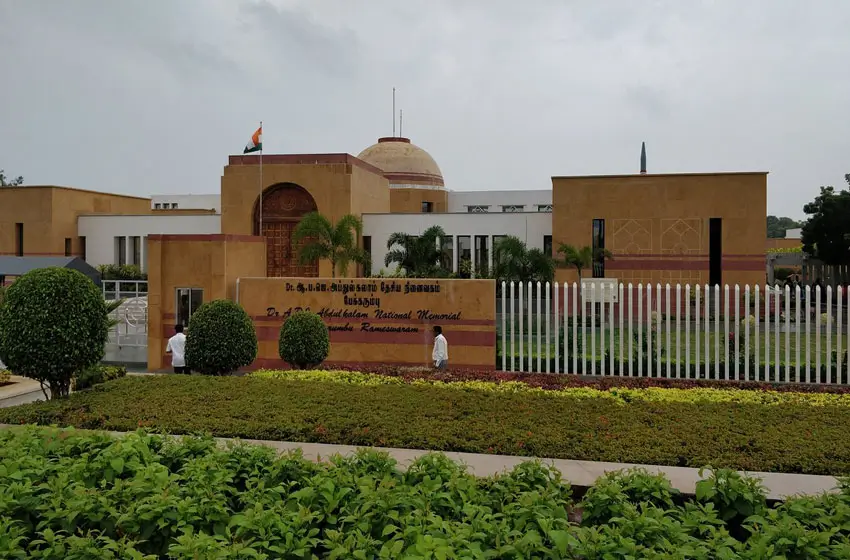
The Dr. APJ Abdul Kalam National Memorial at Peikarumbu honors India's former president and scientist, who was born in Rameswaram in 1931 and is buried here. The building, opened in 2017, combines Mughal and Indian design, and its galleries show photographs, personal items, models of the missiles and rockets he worked on, and paintings from his life. It's popular with Indian families and school groups and gives foreign visitors an insight into a figure much loved across the country. In town, the House of Kalam, his family home, also has a small museum on the upper floors. The memorial is generally closed on one weekday, so check before you go.
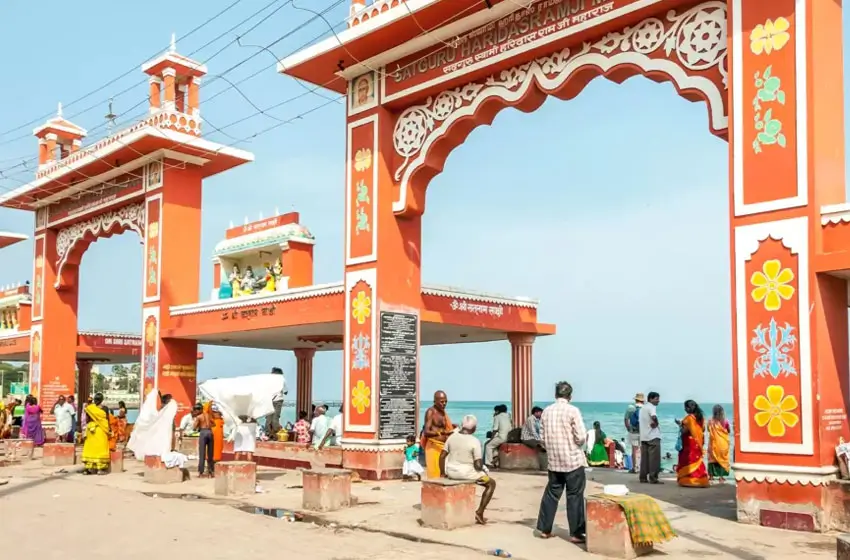
Just east of the temple, Agni Theertham is the stretch of beach where pilgrims take a ritual bath in the sea before entering the temple. The water here is shallow and calm, and at sunrise the beach fills with families, priests performing ceremonies for ancestors, and people dressed in wet clothes heading toward the temple gates. It is a public ritual site rather than a swimming beach, so watch respectfully and avoid photographing people mid-ceremony without asking.
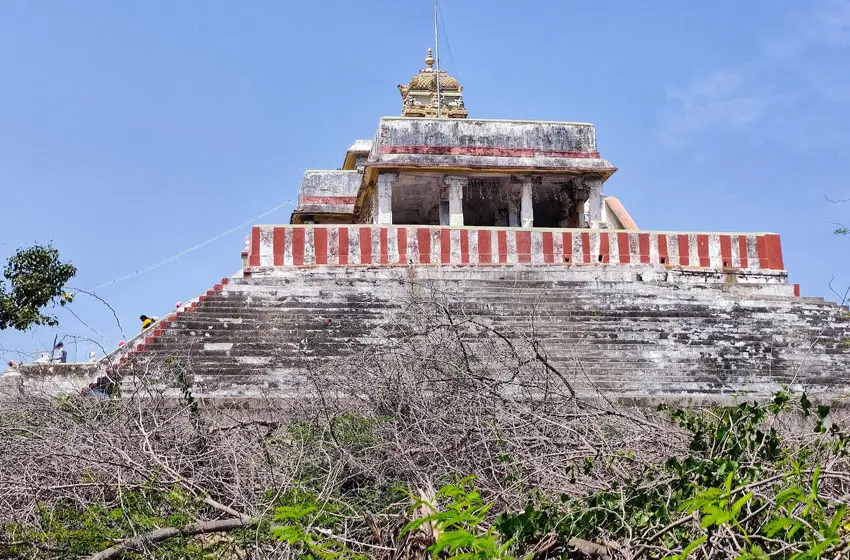
The highest point on the island, Gandhamadhana Parvatham is a small hill about 2 miles (3 km) north of the temple. A two-story shrine on top holds a stone said to bear the footprints of Lord Rama. The hill is not high, but the island is so flat that you get a wide view over palm groves, the town, and the sea. It's a good stop just before sunset.
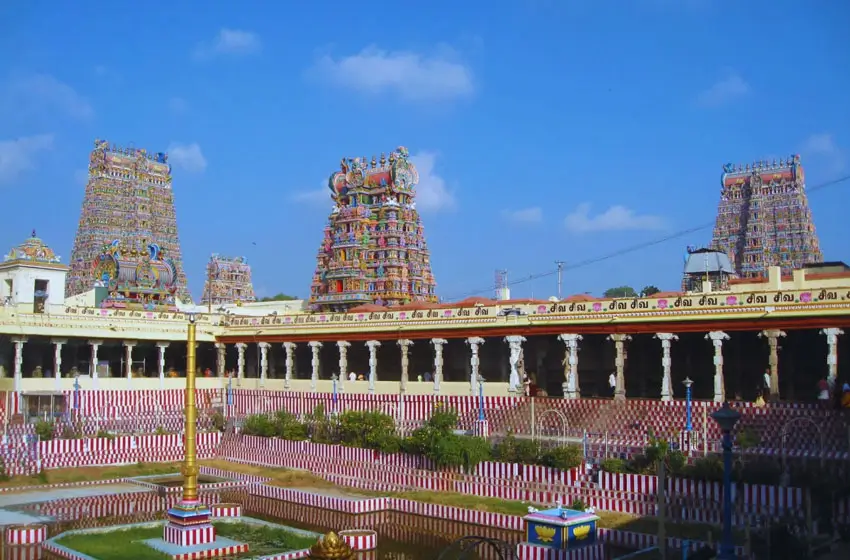
On the road to Dhanushkodi, the Kothandaramaswamy Temple stands on a small sandy rise surrounded by water. It's dedicated to Rama, and tradition says this is where Ravana's brother Vibhishana surrendered to him. The temple is also known as one of the few structures in the area that survived the 1964 cyclone. It's a short stop, but the setting is lovely.
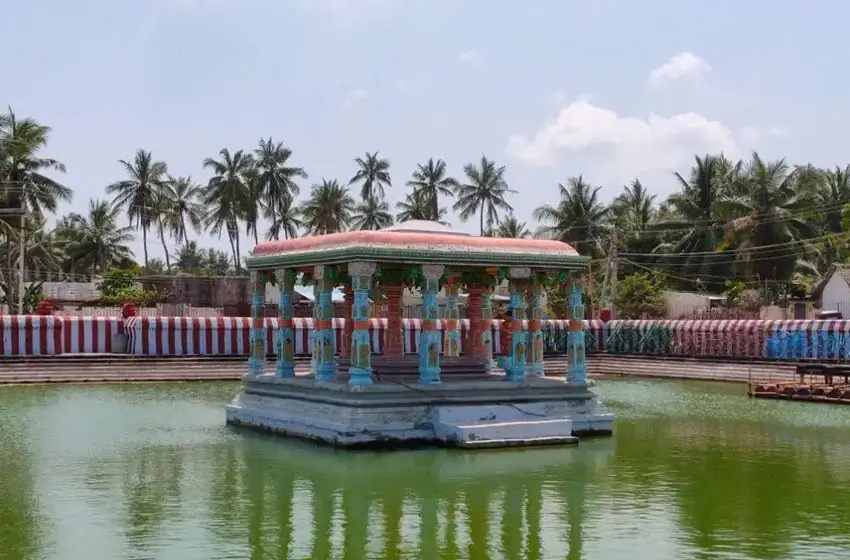
The Panchmukhi Hanuman Temple has an image of Hanuman with five faces, and it also displays large floating stones in a water tank. Devotees believe these are stones like the ones used to build Rama's bridge to Lanka. Geologically they are light, porous rocks, but they are a curious sight and a favorite of Indian visitors. A few other shrines in town show similar stones.
Like what you see? Let's plan it for you.
Private car, driver and hotels arranged around your dates. Reply within 24 hours.
Getting there
Rameswaram is an island town, reached by bridge from the mainland.
Madurai Airport, about 110 miles (175 km) away and about 3.5–4 hours by road, with flights to Chennai, Bangalore, and Hyderabad
Rameswaram Station, with trains running again over the new Pamban Bridge to Madurai, Chennai, and other cities
About 3.5–4 hours from Madurai and 3 hours from Chettinad, crossing the Pamban Road Bridge onto the island
Tours that include Rameswaram
Explore more
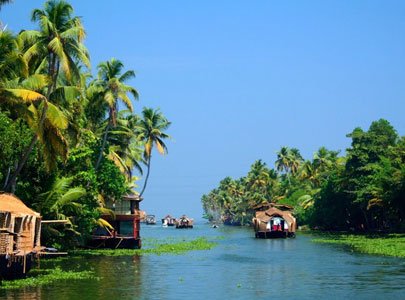
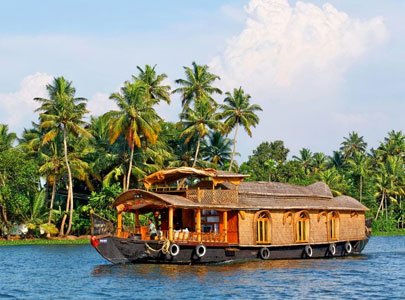
Kerala Backwaters Escape Kerala Backwaters Escape
 Kerala Backwaters Escape
 Kerala Backwaters Escape
N.S. Rathore & Mrs. Omlata Rathore · Managing Director
We still read every enquiry ourselves. Tell us the places you liked and our planners will send a day-by-day route with drive times and a clear price.
No ready-made packages and no pressure to book. A planner from our Kochi office replies within 24 hours with a route written for your group.
Fill this in and your planner will send a first draft itinerary.