Destination
Founded in 1591 by Muhammad Quli Qutb Shah, Hyderabad grew up around the Charminar, the four-arched monument that still marks the center of the old city. For about four centuries it was ruled first by the Qutb Shahi sultans and then by the Nizams, who were once counted among the richest men in the world. Their palaces, tombs, mosques, and jewelry give Hyderabad a character unlike any other South Indian city, closer in feel to the Mughal north, with Persian arches, Urdu poetry, and a famous food culture.
Today Hyderabad is the capital of Telangana and one of India's biggest technology centers, home to large offices of global companies in the western suburbs known as HITEC City and Gachibowli. That gives the city two faces. The old city south of the Musi River is crowded and full of history, with bangle shops, perfume sellers, and the call to prayer from the Mecca Masjid. The new city is all glass towers, wide roads, malls, and modern restaurants. Seeing both is part of the fun.
For foreign travelers, Hyderabad tourism offers some of the best Islamic architecture in South India, an excellent museum, a hilltop fortress, the world's best-known biryani, and Ramoji Film City, a huge film studio complex on the outskirts. With a major international airport, it is also a useful starting point for trips to Hampi, Warangal, and the Buddhist sites of Andhra Pradesh.
Charminar, Golconda Fort, Qutb Shahi Tombs, Chowmahalla Palace, Salar Jung Museum, Ramoji Film City
October – February
Warm, dry days and cool evenings
3 Days
Includes a full day at Ramoji Film City
Telugu, Urdu, Hindi, English
English spoken in hotels, malls, and by guides
About 25 miles (40 km) east of the city center on the Vijayawada highway, Ramoji Film City is one of the largest film studio complexes in the world and has appeared in Guinness World Records under that title. Spread over roughly 2,000 acres, it is a working studio where many Telugu, Hindi, and other Indian films are shot, and also a large theme park for visitors.
A standard visit begins with a guided bus tour across the property, showing film sets of railway stations, airports, palaces, Mughal gardens, a Japanese garden, streets designed to look like various world cities, and the sets used for the hit film Baahubali. After the tour, you can explore stunt shows, live dance performances, a bird park, a butterfly garden, children's rides, and an adventure area. There are several restaurants on site.
Read More +Like what you see? Let's plan it for you.
Private car, driver and hotels arranged around your dates. Reply within 24 hours.
Hyderabad
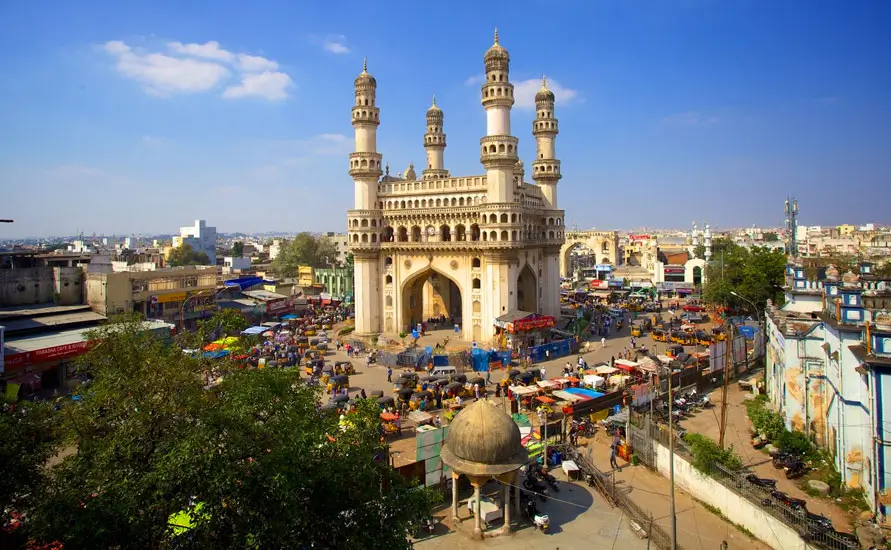
The Charminar is the symbol of Hyderabad and its most famous monument. Built in 1591, it is a square granite-and-lime structure with four grand arches facing the four directions and four minarets about 184 feet (56 m) high at the corners. A small mosque sits on the top floor. Historians still debate its exact purpose, though a popular story says it was built to mark the end of a plague. Visitors can climb partway up for views of the old city's lanes, but access to the upper levels has been restricted at times. The real experience is the area around it, especially in the evening when the arches are lit and the markets are at their busiest.
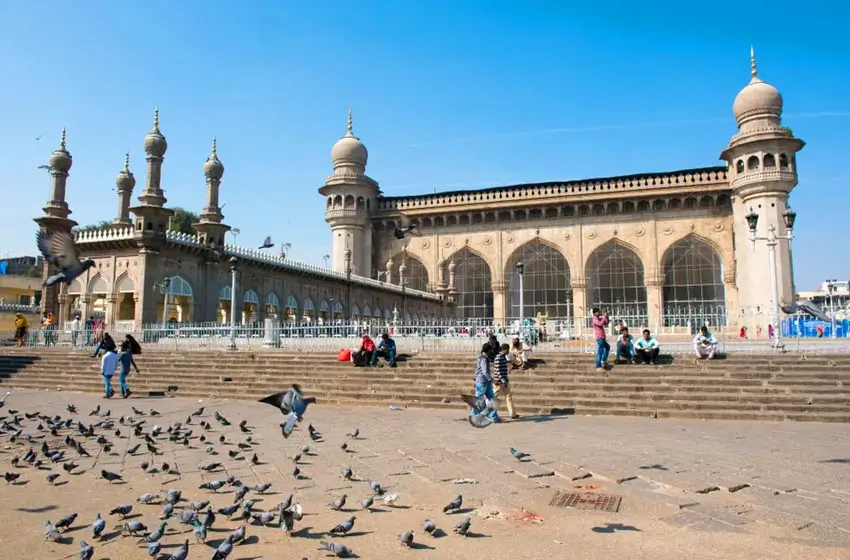
Just southwest of the Charminar, Mecca Masjid is one of the largest mosques in India, able to hold around 10,000 worshippers. Construction began in 1617 under Muhammad Qutb Shah and was completed in 1694 under the Mughal emperor Aurangzeb. According to tradition, some of the bricks over the central arch were made with soil brought from Mecca, which gave the mosque its name. Tombs of several Nizams lie in an enclosure beside the courtyard. Non-Muslim visitors are welcome outside prayer times. Dress conservatively, and women should cover their heads.
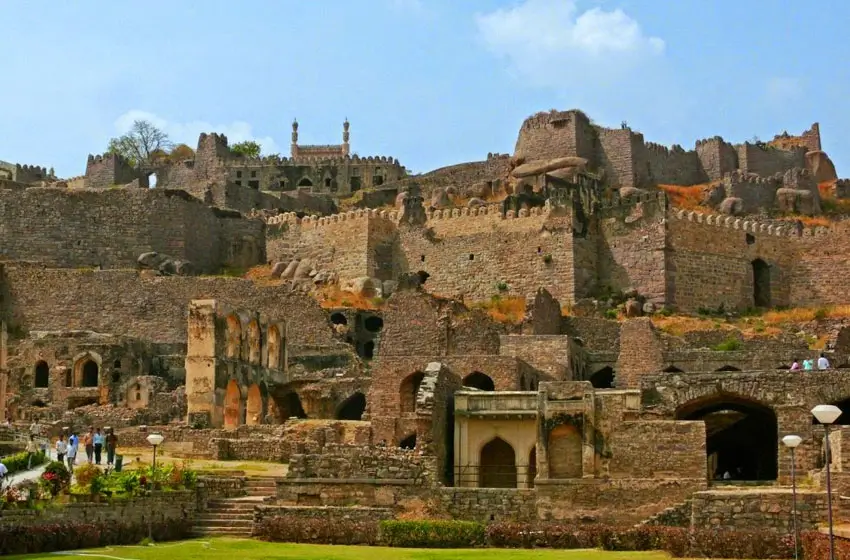
About 7 miles (11 km) west of the Charminar, Golconda Fort was the capital of the Qutb Shahi kingdom before Hyderabad was built, and the area was known for the diamond trade. Diamonds such as the Koh-i-Noor and the Hope Diamond are believed to have come from mines in the wider Golconda region. The fort covers a large hill, with eight gates, outer walls running for miles, palaces, mosques, granaries, and royal halls. The best-known feature is its acoustics: a hand clap at the Fateh Darwaza entrance can be heard at the Bala Hissar pavilion at the top, around 300 feet (91 m) higher. The climb takes about an hour, and the views from the top are excellent. Go in the early morning or late afternoon to avoid the midday heat. In the evening, a sound and light show tells the fort's story, with shows in English and other languages on different nights.
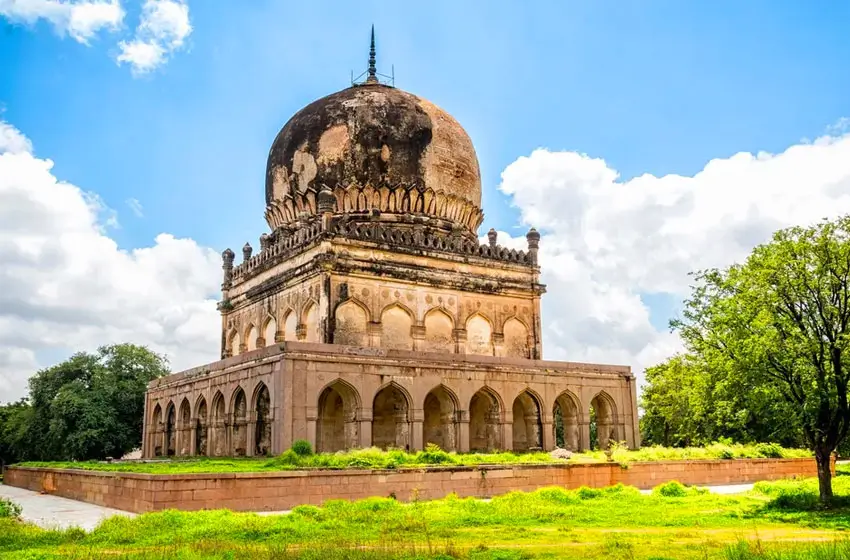
Close to Golconda, the Qutb Shahi Tombs hold the remains of the seven Qutb Shahi rulers and members of their family, in domed mausoleums of gray granite and lime stucco set on raised platforms. The complex, now restored as the Qutb Shahi Heritage Park with help from the Aga Khan Trust for Culture, also includes mosques, a mortuary bath, and gardens. It is one of the most important groups of Islamic tombs in India and far less crowded than the fort. Late afternoon light on the domes is especially beautiful.
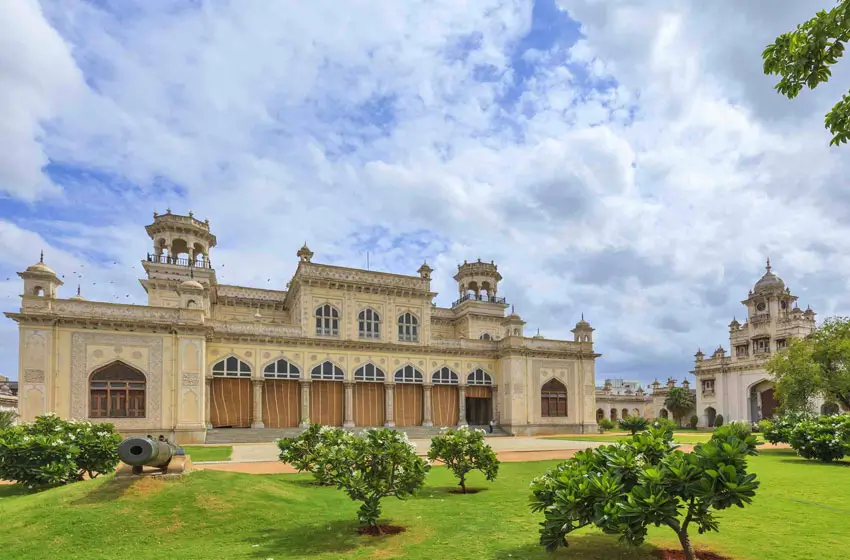
The Chowmahalla Palace was the official residence of the Nizams, where they received guests and held ceremonies. Its name means "four palaces," and the complex includes courtyards, fountains, and the grand Khilwat Mubarak durbar hall with its Belgian crystal chandeliers. Galleries display old clothes, weapons, furniture, and a collection of vintage cars, including a Rolls-Royce. The palace was restored by the Nizam's family trust and won a UNESCO Asia-Pacific Heritage award in 2010. It's a short walk from the Charminar and is closed on Fridays.
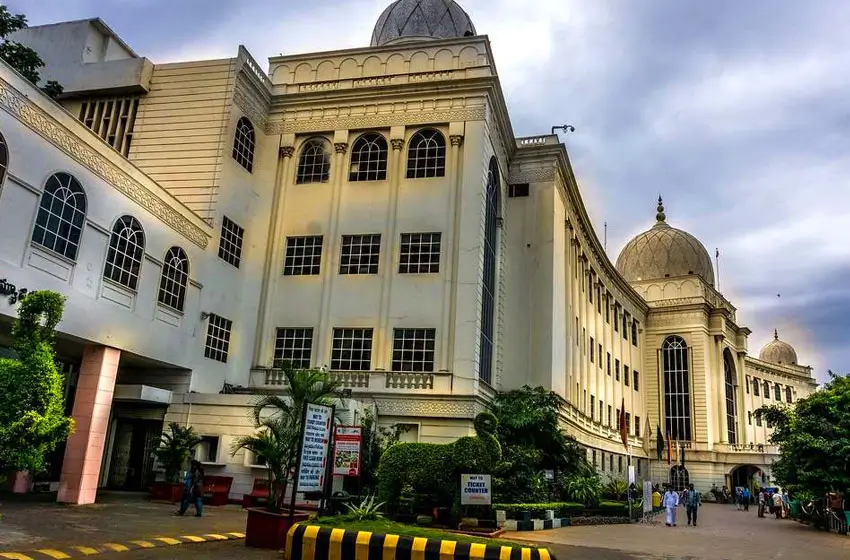
The Salar Jung Museum is one of the largest museums in India, built around the private collection of Mir Yousuf Ali Khan, Salar Jung III, a prime minister of the Nizam's state. It holds art and objects from India, Europe, the Middle East, and East Asia: Persian carpets, Mughal miniatures, jade, ivory, manuscripts, and European paintings. Don't miss the Veiled Rebecca, a white marble statue by the Italian sculptor Giovanni Benzoni, and the musical clock, which draws crowds when a small figure comes out to strike the hour. Allow at least two to three hours. The museum is closed on Fridays.
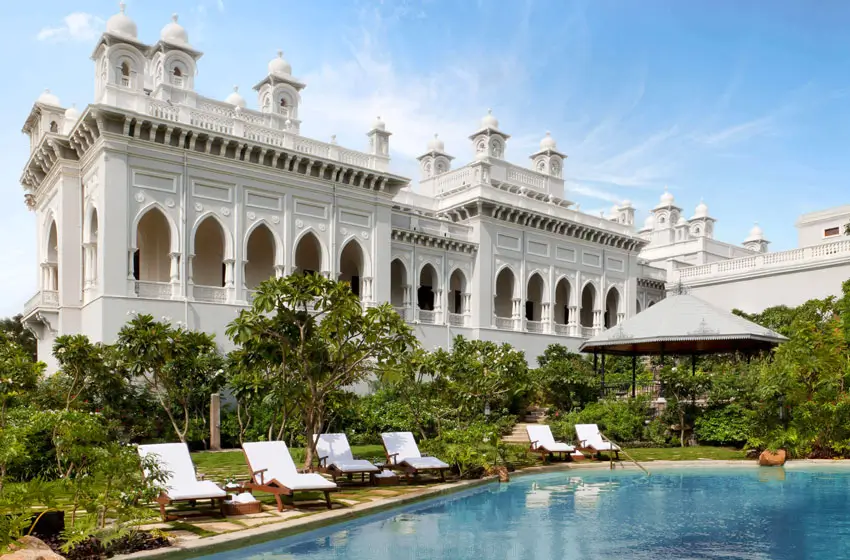
On a hill above the old city, Falaknuma Palace was built in the 1890s for a nobleman, the Nawab Viqar-ul-Umra, and later passed to the sixth Nizam. Its name means "mirror of the sky." Today it is a luxury Taj hotel, with Italian marble, Venetian chandeliers, a famous library, and a dining table that seats 101 guests. Entry is for hotel guests and those with a dining reservation, with a palace tour included. A meal or high tea here is a special experience. Book well in advance.
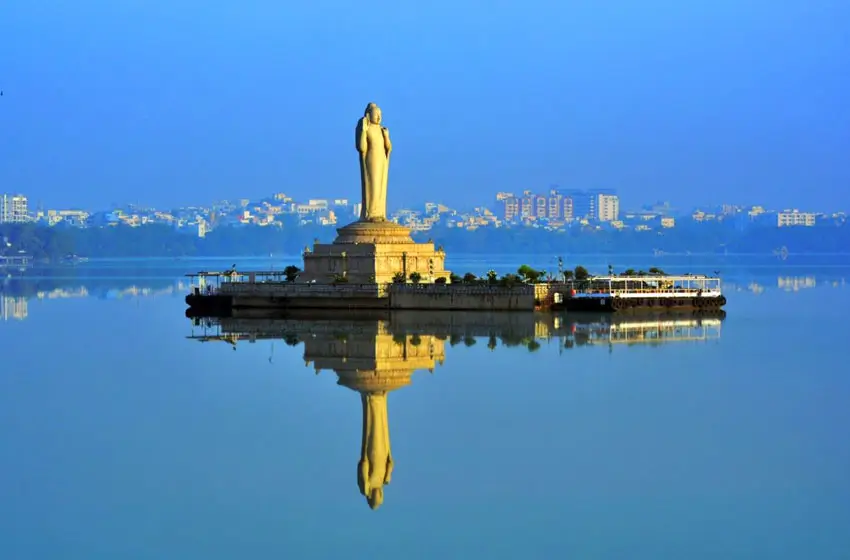
Hussain Sagar is a heart-shaped lake built in 1563 during the reign of Ibrahim Quli Qutb Shah. It connects the twin cities of Hyderabad and Secunderabad. On a small island in the middle stands a large monolithic Buddha statue, about 58 feet (18 m) tall, carved from a single block of granite. Boats run from Lumbini Park and Eat Street to the island. The lake promenade on Necklace Road and Tank Bund is a pleasant place for an evening walk, especially at sunset.
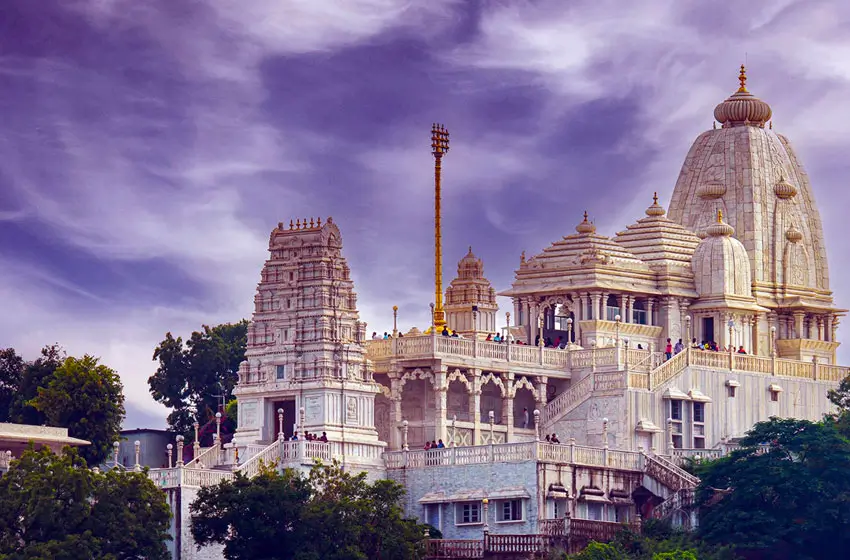
The Birla Mandir is a white marble Hindu temple dedicated to Lord Venkateswara, built in 1976 on a hill called Naubath Pahad. Its architecture blends South Indian, Rajasthani, and Odia styles. The temple has wide views over Hussain Sagar and the city, best at dusk when the lights come on. Phones and cameras are not allowed inside the temple, so leave them in the car or use the lockers.
Like what you see? Let's plan it for you.
Private car, driver and hotels arranged around your dates. Reply within 24 hours.
Getting there
Hyderabad is a major air, rail, and road hub for central and South India.
Rajiv Gandhi International Airport at Shamshabad, with direct flights from the Middle East, Southeast Asia, Europe, and all major Indian cities
Secunderabad, Hyderabad Deccan (Nampally), and Kacheguda stations, with trains to Chennai, Bangalore, Mumbai, Delhi, and Vijayawada
National highways to Bangalore, Vijayawada, Warangal, and Mumbai; about 7 to 8 hours by car to Hampi
Tours that include Hyderabad
Explore more
N.S. Rathore & Mrs. Omlata Rathore · Managing Director
We still read every enquiry ourselves. Tell us the places you liked and our planners will send a day-by-day route with drive times and a clear price.
No ready-made packages and no pressure to book. A planner from our Kochi office replies within 24 hours with a route written for your group.
Fill this in and your planner will send a first draft itinerary.